Regulatory sign
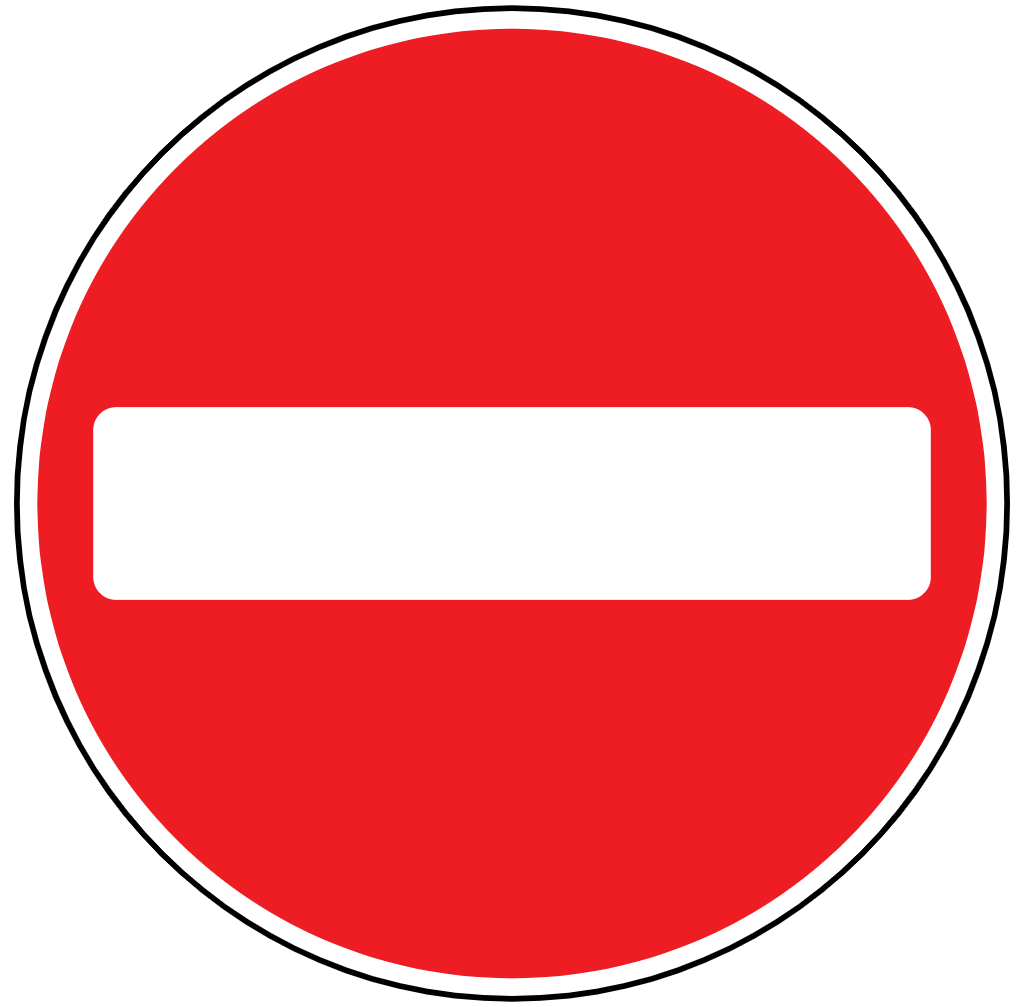
No entry sign
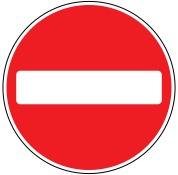
What does the No entry sign mean?
No entry for vehicles. You must not drive past this sign into the road beyond, unless a plate shows that your vehicle is exempt.
Also known as: No entry for vehicular traffic, Red circle white bar sign
What it means
Vehicles must not enter the road beyond this sign. Like other red circular signs, it tells you what you must not do.
You'll typically meet it where traffic is only allowed to travel the other way, such as the far end of a one-way street. In a one-way street, traffic must travel in the direction shown by the signs.
Cycles are vehicles too, so the ban includes cyclists unless there is an exception. Where buses or cycles are allowed through, a plate under the sign says so.
The words NO ENTRY may also be painted on the road. Vehicles must not pass that marking either.
What the symbol shows
Memory tip: Think of the white bar as a barrier across the road ahead.
Where you'll see it
Where vehicles are not allowed to enter a road, for example at the end of a one-way street where traffic flows towards you.
Rules to know
The sign means no entry for vehicular traffic.
Know Your Traffic Signs, p. 17
Where there is an exception for buses or cycles, the sign may be used with a supplementary plate.
Know Your Traffic Signs, p. 17
A NO ENTRY marking on the road means vehicles must not pass it, and may be used with the upright sign.
Know Your Traffic Signs, p. 84
In a one-way street, traffic must travel in the direction indicated by signs.
The Highway Code, Rule 143
What happens if you ignore it
Ignoring a traffic sign such as No entry can lead to 3 penalty points (endorsement code TS50).
Penalty points (endorsements): endorsement codes and penalty points, Endorsement code TS50
In some parts of England, the council enforces No entry signs instead, issuing a penalty charge notice based on camera evidence. Councils outside London have to apply for these powers.
Statutory guidance on civil enforcement of bus lane and moving traffic contraventions (outside London), Moving traffic contraventions
General information, not legal advice. Enforcement can differ between areas.
Spot the difference
No entry vs No vehicles
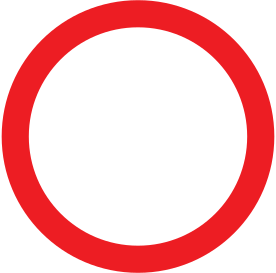
The key difference: No vehicles is a red ring with an empty white centre. No entry is a solid red circle with a white bar across it.
| No entry | No vehicles | |
|---|---|---|
| Looks like | Solid red circle with a white bar | Red ring, plain white centre |
| What it prohibits | Vehicles entering past the sign | All vehicles (cycles pushed by hand allowed) |
| Possible exceptions | A plate can allow buses or cycles | Plates can show times or allow access |
Know Your Traffic Signs, Regulatory signs, pp. 16–17
Common mistakes
Mistake: Thinking cyclists can ignore it.
Instead: It applies to all vehicles, including cycles, unless a plate under the sign shows an exception.
Mistake: Confusing it with the No through road sign.
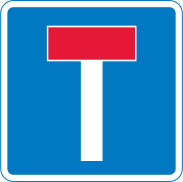
Instead: No entry bans you from driving in. No through road is a blue information sign: you may drive in, but there's no way out at the other end.
Test yourself
Recalling the answer helps it stick. Pick an answer to see how you did.
Question 1 of 2
What does this sign mean?
Full road sign quizzes are coming soon. See what's planned
Download this sign
© Crown copyright. Free to reuse under the Open Government Licence v3.0, as long as the sign is reproduced accurately and not in a misleading context.
Related signs
Often confused with
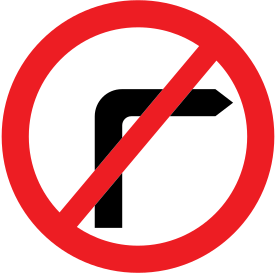
No vehicles
Regulatory sign
An empty red ring: no vehicles at all.
See also
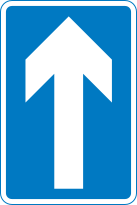
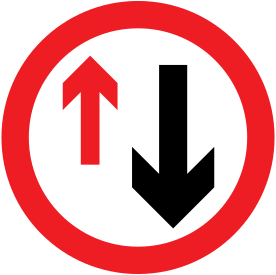
One-way traffic
Regulatory sign
The sign traffic sees at the other end of a one-way road.
Often confused with
No through road
Information sign
You may drive in, but there's no way through.
More regulatory signs
All regulatory signs
Sources
- Know Your Traffic Signs (Department for Transport, Sixth edition, 2023), Regulatory signs, pp. 16–17; Road markings, p. 84
- The Highway Code, Rule 143
Sign image: Department for Transport, Traffic sign images (diagram 616). © Crown copyright, reused under the Open Government Licence v3.0.
Checked against these sources and reviewed by Bikash Thapa, full UK driving licence holder. Last reviewed 4 October 2026. This page explains the sign in our own words; for the full rules, see The Highway Code. How we source and check content